Our book
Vagamonde: Chasing Euphoria and Getting Hit by Reality
is now available on Amazon.ca, Amazon.com, Amazon.co.uk, Amazon.fr,
Amazon.de, Amazon.it, and Amazon.es
In Montreal: at Bertrand bookstores

Saturday, February 25, 2012

Coasting the Konkan all the way to the tourist oasis

January 10, 2012 - January 24, 2012

My cold is getting better and I managed to download a GPS track that will take us all the way to Goa: things are looking up. One morning, the track takes us onto a turnoff. The road is quiet and traffic free. We go down a hill and the road gets narrower and narrower till it becomes a foot path that leads us to a beach. The beach is deserted, clean and the villagers stare at us as though they've never seen tourists. Looking down at the GPS I can see a straight line on the map all the way to the other side of the bay. Conclusion ... we have to back track to the turnoff.

Once back on track we realize that the countryside is getting much cleaner. We pass by a picturesque river with pristine water and virtually no garbage.


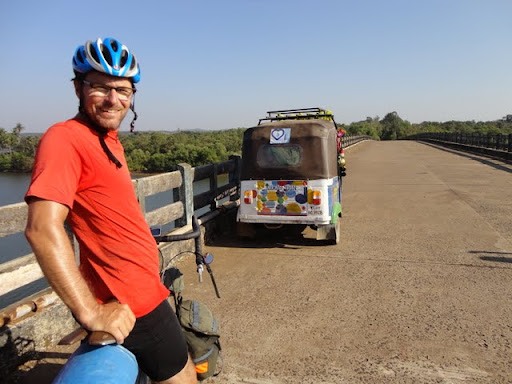
On a bridge crossing, we encounter three british folks who are travelling in a rickshaw. They are part of a friendly race across India. In the Kormageddon, they've come all the way from Jaipur; doing a few hundred kilometres a day. We all hang out on the bridge which bounces up and down every time a truck goes by. With their british accent that omits most t's, they tell us about their adventure ... we do the same.


We are all heading towards Malwan to spend the night. I look on the GPS for some accommodation and the only thing that shows up is Hotel Swastik. India is covered in swastikas. You see them on temples, cars and houses.


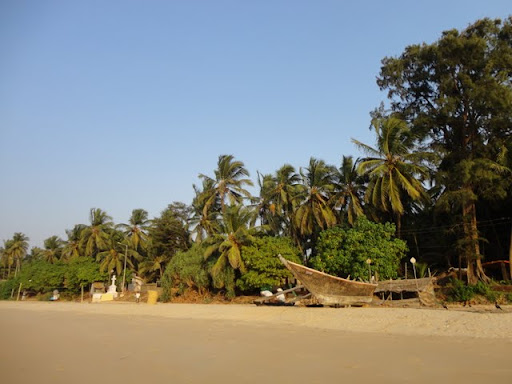
I haven't done my homework on this but I believe its symbolism is far removed from the evil one we know so well. We skip Hotel Swastik and end up staying in cheap beach bungalows for three days. My cold still lingering, I refrain from swimming; sticking to walks on the beach where the eagles and crows are in a perpetual dog fight above the coconut trees and the crabs create miniature sculptures on the sand.


As we leave Malwan, we take a detour to Maltaki beach; a beach all the way out on the tip of a peninsula. This gives us a late start and on the way back, we stop for lunch at a familly restaurant of questionable cleanliness: the food ends up being really tasty. Like much of India, in front of the restaurant are several cows. One of them is grazing on plastic bags as though it was Scotland green. The bags are gobbled up in one go and disappear straight towards the four stomachs. Not the most appetizing sight but we are really hungry.

Back on the road and I'm leading the pack on a downhill. At the bottom, school just let out and kids are running all over the place; yelling out things I don't understand. I stop a ways down the road and wait for Michèle and David but no-one comes; something is wrong. I turn back and see that they are both surrounded by kids. I come up and ask:
- What happened?
David replies:
- I ran over a kid!
I look over to see Michèle patching up a child's knee. The scrape looked pretty bad but overall, he seemed okay. We pedal on.

Michèle comments: I was trailing the pack on that downhill, with David slightly ahead of me. I saw the whole thing when David ran over that kid. We had both slowed down because so many kids were criss-crossing the road. The kid that David would run over was crossing the road at a lazy pace. Other kids started yelling something at him. Then he did what I would call a squirrel manoeuver. If he had just kept going, even at that lazy pace, he would have made it to the other side unscathed. But like squirrels do, he turned back in the middle of crossing the road and stepped right into David's path. The kid cringed, David braked hard, but the impact was inevitable. The kid's sandals flew off and he got a nasty scrape on the knee as David's front tire rolled over him. Before the kid could get up, an older man appeared and started yelling at the poor little guy. I didn't need to know the language; the tone said it all.
- Do you want to get yourself killed? What if that had been a motorcycle and not a bicycle?
By the time I found a large enough bandage in our med kit, a crowd of a hundred curious classmates had gathered around. The kid seemed grateful for the bandage but he had a look in his eye like he wanted the earth to open up and swallow him away from all this attention. He would be okay. His embarrassment was bigger than his injury.


My cold is finally over but David and I have a nasty cough which I'm blaming on the atmospheric pollution. People here tend to burn their garbage (when they get to it) and cook on open fires. Add cars and general progress to the lot and multiply by a billion. The result is smog that envelopes the whole country and probably spills over onto others.


So, after my four hour coughing fit during the night, we ride out bright and early. The traffic seems to get busier and at one point we get to an area that looks like a truck convention. Hundreds of them parked by the side of the road.


Then we see something that we haven't seen in a long time; white people. Goa must not be far. Then, all of a sudden, it's dread locks and patchouli; hundreds of them barrelling down the road on rented scooters. We follow the flock all the way to Mandrem. Once there, we try to get orientated by asking directions from a ratty looking woman who is walking towards us. First, David asks her a question and gets completely ignored.
- I think that woman is French he says.
Then Michèle gives it a try with the same result. When the woman walks by me, I don't bother saying anything: she is not concerned with us mortals. I just watch her slowly walk toward the sunset.

Michèle comments: A bizarre transition as we passed from Maharashtra to Goa. First, the trucks: hundreds parked and hundreds more coming. We couldn't figure out why there were so many. Whatever the reason, it was a depressing sight. Next, the tourists on scooters, almost outnumbering the trucks. It made me extra nervous to be in that traffic: the large loud belching trucks and the tourists trying to pass them, no-one paying much attention to us little people on bicycle. Then, that snotty woman: why she was so blatantly rude, I'll never know. It was just such a striking contrast to the overly helpful Maharashtrans when it comes to giving directions.

Mandrem is a nice place. On the beach are people meditating and doing sun salutations. Fifty metres away are packs of Russian tourists getting shitfaced. No need to swim fully clothed like they used to do in Europe in 1910; it's tits and ass everywhere. The restaurants are pricier but excellent, and there's wi-fi everywhere. Goa really is a tourist oasis where you can take a break from culture shock.


Michèle comments: Goa is an escape from India while still in India. At first, it annoyed me to be amongst the droves of tourists. But then I decided to get over it and just enjoy the benefits of the tourist bubble. Having real coffee, for one thing, and sipping on tax-free, i.e., cheap, port wine, readily available in the formerly-Portuguese state. At Mandrem beach, many signs are in Russian, and even on Google maps, its name appears in cyrillic script. No wonder that place is dubbed Moscow beach.

Next to our place is a puppy that is kept tied up all night. It is yelping so loud that the sound goes right through my ear plugs. After hours of trying to get to sleep, I burst out of bed cursing my face off. I reach into my pannier for my knife and storm out. I grab the puppy and wedge my knife between its neck and collar. In one stroke I slice the collar to cut him loose (you didn't thing I was going to kill a puppy did you?). Proud of my good deed I walk back to the house to finally get some sleep. The only problem now is that the puppy is at my heels. So, I slam the door in its face and head to bed. About five minutes later, the yelping starts again but this time it's right outside our window.

Next stop is Anjuna. No nice beaches here. The only attraction for us are yet another batch of friends from Turkey and Iran. Tommie and Marie are here pursuing a yoga course that will allow them to teach. On top of it, they have left their bicycles behind and bought a motor bike. We have dinner and a few drinks, share travel stories and future plans. They give us encouragement for our summer idea: more on that later.


Michèle comments: It felt good to share the ups and downs of long-term bicycle travel with Tommie and Marie. They have been on the road from Holland since May 2011. They understand how easy it is to become discouraged and how dreams of the future are sometimes the only things that keep us going. The evening drew to a close and again we went our separate ways, saying 'au revoir' because it feels certain that we will meet yet again. Happy continued travels, you two!

We leave Anjuna to go to a town called Panaji to get our Hep A booster. Despite India being a prime location for medical tourism, the vaccine cost us more than in Canada; go figure. To get to Panaji you must use the main highway which means heavy traffic or in other words... a shit ride. Once there, Michèle and David go hotel hunting while I sit quietly trying to calm my nerves from riding in heavy traffic all day. Then a man stops in front of me. "Don't ask" I say to myself, but of course he had to.
- Where are you from, he asks in broken English.
I struggle to put on a smile but a full day of blaring horns in my face prevents me.
- I don't remember, I tell him.
He gets really offended as though I was denying him something vital; then he storms off.

Later on, the straw breaks the camel's back as the penny pinching gets to me. At a photocopy shop, we copy four passport pages onto two pieces of paper. The charge should be for two copies but the guy charges us for four. Despite the charge being next to nothing, this prompts me to scream at the guy for a good minute with veins popping out of my head. After draining my frustration, next comes the embarrassment of an uncontrolled spaz: I head straight for bed.

The next day we leave Panaji in the midst of rush hour. Then, it's mostly heavy traffic all day as every blaring horn tries my patience. The ride is long but we get some light traffic towards the end. Once we make the turn off to Agonda, we are greeted by the one and only tree that is inhabited by hundreds of giant bats. At sunset, they all fly off in a massive flock.


Agonda is another tourist oasis where the food is great and the coco-huts are cheap. Not much happens here aside from sunbathing.


Woke up after a bad dream: the ferry to Sri Lanka was booked solid for months in advance. Turns out that the reality is the opposite; the ferry is not popular enough and has been discontinued. For us, this mean another plane hop and all the exotic security incompetence that comes with it. More on that later.

Michèle comments: Bad dream is right. What a disappointment to find out that the ferry was no longer running. This was a brand new ferry service, having been launched in June 2011 after some 30 years of no ferry connection between India and Sri Lanka. It was near impossible to get any official news of the service cancellation or if it would be resumed. The ferry company was not responding to emails and its website was 'temporarily offline' or something equally as vague. Without anything better to go on, we resigned ourselves to there not being a ferry. We brainstormed many options, all of which had to include a flight. Originally, we had thought our three months of cycling with David would be two months in India and one month in Sri Lanka. Finally, we opted for the other way around, cutting our time in India to one month. Hopes of clearer waters, for snorkelling, and of clearer air, for breathing, were among the reasons that led to our choice.

I leave Agonda with a tear in my eye; so comfortable there. The ride to the airport is about fifty kilometres to a town called Vasco de Gama. On the way we can see that some of the giant bats had the misfortune to take a rest on a power line.


As we go into Vasco de Gama, we are greeted with the usual: a sea of refuse filled with all the semi-domestic animals.


We find a mediocre hotel that has satellite TV. Flipping the clicker box, we end up on a movie channel showing Romancing the Stone and after that, Conan the Destroyer. For our final night in India, we sit back and watch Arnie wield his massive sword to fight the bad guys.

Michèle comments: Ahhh India. Nostrils assaulted by the stink of pollution and garbage, then soothed by a sudden waft of delicious smelling food and hints of incense. Ears blasted by non-stop honks in busy Mumbai, then calmed by the waves on the beach and nothing much else along coastal Maharashtra. Not nearly so scary a cycling destination as we were led to believe. Maybe we'll go back again some day.

All our India photos are here.

Friday, February 10, 2012

Coasting the Konkan with David

December 27, 2011 - January 9, 2012


Walking around Mumbai, we stumble upon an antique store. The owners are very friendly and are eager to show us around even though it is clear that we won't buy anything. One of the patrons gives me a quick lesson on Ganesh. Ganesh's head was cut off by Shiva. When Shiva realized that Ganesh was his son, he quickly replaced Ganesh's head with the one of an elephant. Ganesh is the remover of obstacles. His multiple arms hold attributes: the coconut and lotus flower are symbols of purity. A lover of sweets, Ganesh can be seen holding sugary treats. At some point, Ganesh needed to write down something quickly and could not wait for someone to bring him a pen. So, he cut off his right tusk to use it as a writing implement. His vehicle is the mouse, which I'm guessing means that he uses mice to travel around in this world (please don't hesitate to correct me). Being the remover of obstacles, Ganesh is a very popular in capitalist India. Hopefully he can remove some of the garbage and put it where we can't see it. Just like we do in the first world.

Michèle comments: I was thoroughly captivated by the owners describing the antiques. Like a child in Kindergarten at story time. There were ornate door frames and side panels of the huge temple chariots. There were many carvings, big and small. One piece was a large sandlewood carving of Ganesh in a reclining pose, his rotund belly encircled by a cobra belt. With the broadest of grins and dancing eyes, the taller of the two owners described the details of that carving of Ganesh like he was talking of an old friend. I want to find a copy of the reference book they had in the shop: "Living Wood: Sculptural Traditions of Southern India". I just wish the shop owners could pop out of the book and make those pieces come alive as they did for us that day. The antique showroom was in the basement of the Jehangir Art Gallery if you want to find the place yourself.

Back at the airport, David finally gets his bike from customs. As he opens the bike box he yells:
- It's show time!
After which about twenty airport employees gather around to watch us assemble the bike.


Once the bike is assembled, we ride out of the airport shining like royalty. For the third time, we ride into downtown Mumbai, this time for another three day visit.


It's once again sensory overload with its traffic, smells and the exotic poverty.


Michèle comments: In all fairness to Mumbai, I want to add that Benoit's drawing could be depicting a scene in Canada. Just choose a large city there and you wouldn't have to look far to find someone passed out on the sidewalk with people hurrying past on their way to their busy lives. Perhaps with less garbage strewn on the streets in the Canadian scene. Perhaps not. As Benoit mentioned, first world countries like Canada put the garbage where we can't see it. Out of sight, out of mind. Sometimes we don't give a second thought to how much garbage we generate. Like the use of toilet paper. When buying a roll of toilet paper in Mumbai, we wondered why it cost so much. The shop owner set us straight explaining that it is a luxury item in India. Right then and there, we decided to give up the ol' t.p. and just use water. I'll be the first to admit that it is easier said than done.

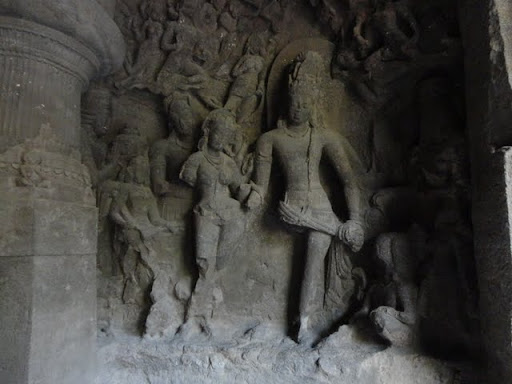
One day was spent going to Elephanta Island where you can see ancient caves containing large statues of various Hindu gods. Despite the large crowds, the site is fairly impressive.


However, like good capitalists, the Indians don't miss an opportunity to make a buck: on our way there we realize that the entrance fee is 25 times more for foreigners. You can think of it as a 2500% tax with a dash of racial profiling. The amount only adds up to 5 dollars but it's the principle that gets me. After a good rant and still pissed off about the new found fact, an Indian tourist asks me if he can take a picture of us. I tell him that it will cost him a hundred rupees. He gives me a confused look and laughs nervously. He didn't end up taking the picture.


The next day was spent at Mumbai's court house. In order to get in you have to wear pants and leave your camera at the entrance. Once inside it is difficult to know if the place is crumbling or if it is being renovated: there is rubble everywhere. Tarps covering windows and doorways and you have full access to any room or stairwell. Not really knowing where to go or what to check out we start going up random stairwells and walking down various corridors. Some of the offices are jam-packed with papers and folders stacked like mini skyscrapers. At some point we end up on the roof to go down yet another staircase that brings us to the other side of the building. Having a blast we keep going with our visit, when all of a sudden, an aging security guard, half asleep in his chair, jumps up and starts running towards us yelling that we are in a restricted zone. Very nervous and agitated, he escorts us back down to the entrance, yelling at the guards at the various check points along the way: the ones that were supposed to deny us entrance. Back at the main gate, the security guard goes in to talk to the chief who doesn't seem to really care about anything. After explaining to them what I just explained above, we are set free to keep going with our visit.


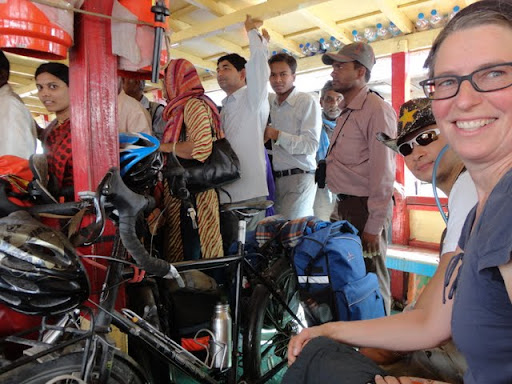
A little disgusted with the double economy, we decide to skip the Ajanta caves and head south towards Goa. Our journey starts with another boat ride across the bay: the same one we took the week before. This time, bikes are not allowed. After a ten minute argument with a set of security officers, the bikes are magically allowed again. While on the boat, someone has the great idea to start throwing potato chips at sea gulls. Before long, the boat gets swarmed with birds and all the excrements that come with it. Once the bag is empty the man discards the package overboard before getting another one to keep the fun going. But, like all fun it eventually gets boring and the man sits back down again. The arm wrestle with my bad eye cover rages on.

We start cycling down the coast. It's around New Years and hotel prices are through the roof. This is where we encounter some Indian generosity. At one guest house we meet a set of young guys. Ten of them are sharing a small room. After starting up a conversation, we tell them that there is double pricing going on. They are paying half of what the hotel wants to charge us. This prompts one of them to step up and offer to pay the difference. We tell him that it's very generous but we can't accept: we will try our luck somewhere else. Down the road, we bite the bullet and check in to another overpriced hotel. The same conversation starts up with another guest. This time, when we tell him the rate we are paying, he says nothing but offers us a bottle of whisky. After this day of cycling it was much needed.

Difficult to find accommodation during the holidays here in India. At some point during the ride, we see a sign that says "Camping". We go and investigate and we are led through a field and onto a beach. Once at the camp site, we can see several tents and tables. We figure that they are trying to sell the concept of a camping resort. When we ask him the price for one night the guy give us a quote that defies comprehension. One hundred and fifty dollars per person, per night. After a good laugh we walk away.

We end up spending New Years in Murud. Partying not being on our agenda, we do the count down in our sleep. I'll spare you the details of what the beach looked like after a News Years Eve party. Most people were heading home but some were staying an extra day to get in a few more cricket games. On the beach, car and motorcycles are doing a hundred clicks on the packed sand with people hanging out of windows and riding on the roof; insane .. just insane.


Michèle comments: One morning in Murud we go in search of breakfast. Near the beach, there are many street stalls selling a variety of food. In one, we thought we saw a woman making "poha", a flavourful breakfast dish of rice flakes and chillies and spices. Turmeric gives the poha a lovely yellow colour. Spying a crate of eggs next to her pans, we thought that we should up the protein content of the meal. So we ask if we can have some fried eggs too. The woman looked confused. But she did as we asked and soon presented us with our breakfast meals. It turns out that she was making scrambled eggs with chillies and spices. No wonder her confusion! We had just asked to have eggs with our eggs.

We stay one more night in Murud and head out the next day: finally, some traffic-free riding. As we wind through coastal roads, we stumble upon an ancient temple. No crowds or entrance fee here. The place is deserted. We park our bikes and take our time walking around the site.


The unbeaten track that we're following has a series of rivers that are linked by ferry. With no track for our journey, the GPS is next to useless; negligence on my part. We end up wasting a day going around in a circle trying to find one of these ferries. However, people are very helpful and they generally point you in the right direction. With David it's easy; he'll go up to anyone in a flash to ask directions.


Michèle comments: I had heard some 'bad press' about the kids in India, how they swarm around your bicycle, touching everything, switching your gears and generally crossing WAY into what we Westerners perceive as personal space. But what we experienced with the school kids in India was quite the opposite. As we cycled the small back roads, invariably we'd pass groups of kids as they walked to school. The young boys would race us, trying to run alongside as long as they could. A difficult endeavour when they were carrying knapsacks that looked heavier than them. But never did they grab at our bicycles or impede us in any way. If we stopped at the roadside for any reason, yes they would swarm us. Yet they were so polite in their swarming that it was even a pleasure to be amongst them.

Around these parts, getting lost is okay. The jungle offers a free show as we ride by gangs of monkeys, peacocks, jackals and all sorts of exotic vegetation. With less population there is less refuse and your imagination can run free. I try to imagine this place hundreds of years ago, when purity was not limited to lotus flowers and coconuts.

As we gently pedal down the coastal road the day-dreaming gets to us. While David and I are cycling side by side, David cuts in front of me. I swerve hard to the left and end up falling on the asphalt. Luckily not much damage. Just a few scrapes and bruises.


Camping has become difficult. The nights are cool and we don't have our sleeping bags. We could buy blankets but David and Michèle seem reluctant to camp. It's too bad because there are lots of interesting places to set up. When camping is not an option you are dependent on guest houses and hotels. This can be very stressful. One evening we get to a hotel tired and hungry: the hotel is full and it's getting dark. This is one situation that I absolutely hate about travelling; to the point of having thoughts of going home. We get word that there is another town with several hotels. It's only fifteen kilometres but Michèle and I are finished. The next logical step is transport.


David decides to cycle it. Michèle and I pile our bikes and panniers into two auto rickshaws and get dropped off at the shittiest hotel yet: we are told it is the best one in town. No matter, it has a bar next door! An hour later, David shows up with his classic open line:
- Namaste!
or hello in Hindi.
Glad to be taking a load off we head to the bar which is also a restaurant. All three of us sit down amongst the heavy drinkers; not a single woman in sight and not a single guy eating dinner. A few minutes later, a nervous waiter comes up to us:
- You must go to the family room he says.
I imagine mom, dad and the kids going out for shooters but in reality the middle ages are not far behind: women are not allowed in the bar.

Michèle comments: It barely phased me that we were shuffled out of the bar and into the family room, all because of me - gasp - a woman in the bar/restaurant. I was too tired to care. The night before we had happened upon the nicest hotel room we've stayed in yet: a little jewel of a place in a village so small that it consisted of only one intersection. The contrast with the hotel we now found ourselves in was shocking us to numbness. I can't find the words to describe the filth on the curtain in our room. David in his eternal cheeriness chirped, "Oh I've seen worse!!" But still, he went out to investigate the other lodging options, returning with a sigh of resignation to announce that yes this was the nicest hotel in town. It was strangely fitting to see this misspelling on the hotel entrance wall:


On the subject of english, I love the beautiful formality of the english we hear spoken in India. A man exclaimed when he heard that we had cycled in Mumbai, "There are not many who would have the courage to dare it." Then, there are the charming mispellings on signs that have english in them, like the one advertising "Engine repair and spear parts", or so many in the menus:
- Creeps with chocolate sauce
- Banana filters with chocolate rum sauce
- Massed potatoes
- Green piece masala, or Green peace masala.


We wake up early. I feel like shit due to a lingering cold. There was also a four hour coughing fit in the middle of the night. As we pedal out, my legs feel like lead weights. I keep radio silence as I try to muster up enough energy to keep moving forward. At a rest stop we see several cyclists off in the distance: slowly inching their way towards us. Then we realise that it's our friends from Turkey and Iran. Geoffroy and Elodie are heading north on their spaceship tandem. We spend an hour exchanging stories and split once again.