October 31 - November 24
In the last post we were up in the mountains hanging out with an unusual Zoroastrian named Ahmed. The next morning we pack up and head out. Ahmed was right, we did not see each other again. About a kilometre into the ride, we join back with the main road and it's back to the unpleasant busy traffic. Luckily for us, it's downhill to the next town. Once there we meet up with a guy who shows us his collection of pictures that other travellers have given him. As we flip through some images of Amsterdam, a picture of a sex shop shows up.
- We don't have these in Iran he says.
The pictures show various sex shop paraphernalia including a mannequin wearing a strap-on dildo.
- Is that for lesbians? he whispers.
I should have said "Not necessarily" but instead I just nodded. We end up giving him some of our travel pictures and it's time to head out again.
With no secondary roads to Yazd, we hop on a bus. We are curious about this city because of a poetic email we received via our website:
"I'm currently living in Yazd and will be more than happy to assist you while you are here. We have a small orchard in the suburbs of Yazd which is relatively quiet and cozy. I'm thinking maybe you're interested in staying in the orchard while you're here. The mornings are beautiful when the sparrows start their symphony in the pomegranate trees and drink from the pool and the sky is amazingly clear at night when you can find your favorite star in Yazd if you haven't found it yet during your journey."
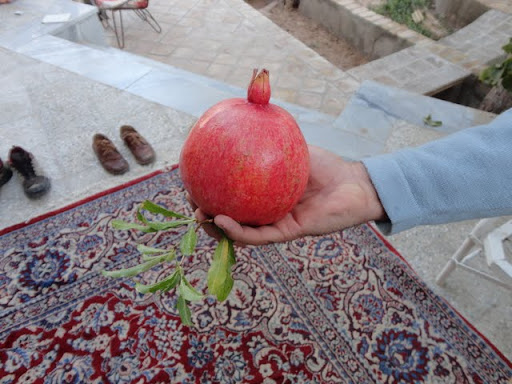
Throughout the whole trip we kept saying to ourselves "we must contact Pomegranate Guy"; and let's keep calling him that because his views differ slightly from the status quo. At first, we thought we would have to camp in his orchard but upon arrival, we find that it has a house connected to it. I've said it before and I'll say it again, when on a long cycling trip, it is a great feeling to be offered a comfortable place to rest for a few days. Pomegranate Guy speaks fluent English and acts as our guide for the duration of our stay in Yazd: giving us a break from the culture shock. As we get to know him better, he gives us a glimpse at the general frustration of the modern Iranian. As we drive through the streets of Yazd, we get to a narrow section where only one car can pass. There is car coming in the opposite direction but we get to the narrow section first. Inside the waiting vehicle are two mullahs.
- We won't let them pass and we won't thank them either because they are mullahs and they ruined our lives he says.
At his place, he flips through some of the thousands of channels made available by his illegal satellite decoder. Iranians have many ways of getting around censorship. Be it legal or illegal. There are special programs to get access to blocked websites. You can even go as far as marrying someone temporarily in order to have sex with them legally. Gay marriage not included of course.
- What about the Iranian channels I ask.
He starts flipping through them with a gentle scorn. Criticizing every detail. It is easy for us to dismiss this frustration as entertainment because we have never experienced life in an oppressive regime. We must always keep ourselves in check that things are not as funny as we may think.
The next day, it's back to driving around Yazd. At one intersection, Pomegranate Guy points to a pack of Afghani refugees. Like Mexicans in the States, Afghanis come to Iran to do the work that Iranians don't want to do. It is easy for them to cross the eastern border that spans a vast desert. Once in Iran, they usually become cheap labour for construction sites. The dizzying heights of misfortune always astound me. How lucky we are to be vagamonde.
Well, we want to thank Pomegranate Guy and his family for their hospitality. We hope that he will get his wish so that we can one day meet up in New Zealand. Before we leave, I ask one last question. How is Iran on the football world stage? He tells me that Iranians are not concerned with that. They only care about beating all the Arab countries.
Michèle comments: We have met many Iranians who are very curious about what life is like in Canada. I feel kind of bad that they stumble upon us as their window to glimpse into that world. No car, no house, no cell phone and no desire to have these things: I wouldn't call us typical Canadians. I was trying to explain all this to a young Iranian man who wanted to know about our life in Montreal. He looked at me, stunned with confusion, like a sci fi computer caught in a loop of illogic: "Does not compute, does not compute." He asked about children. I said that we didn't have any. He was silent for a while. You could almost hear the whirring in his brain as he was trying to make sense of it all. Then: "If you did not have finance problems, then you would have children, yes?" I had to smile at what he came up with - that we had to be desperately poor, or else we would want the car, the house, the family. I didn't attempt to set him straight. How does one discuss such personal life choices with someone who probably would be shocked that I prefer my tea without sugar?
From Yazd we turn our handlebars towards Shiraz where they used to make great wine back when the mullahs didn't have a say in it. Now all that is left is the word Shiraz written on bottle labels at the liquor store. The road on the map shows up as secondary but it's the usual busy highway ... sigh. The scenery is mediocre but we do find a nice camping spot in an abandoned orchard where there is a neglected garden containing eggplants and tomatoes: We help ourselves.

After dinner it's lights out even though the sun hasn't completely set. A few hours later, we are quickly woken up again by howling jackals. Some of them sound like they're just a few metres away but as soon I get out, they vanish from sound and sight. We have yet to see one but you do see their dens which seem to be scattered all over the place.

The next day it's time to feel under-the-weather; low energy and headaches. To add to the discomfort is a strong head wind and something we haven't seen in months: Rain clouds. On top of it there is a steep climb. Fortunately for us we are not gifted with the toughness of some adventure cyclists. Nor do we feel shame in finding other solutions for shaving off kilometres. So, for the first time, we try hitching a ride. It takes about five minutes for Yosof to stop with his Zamionette. Zamionette is the name we have given to the Zamyad: An Iranian-built pickup truck that comes in only one colour; blue.
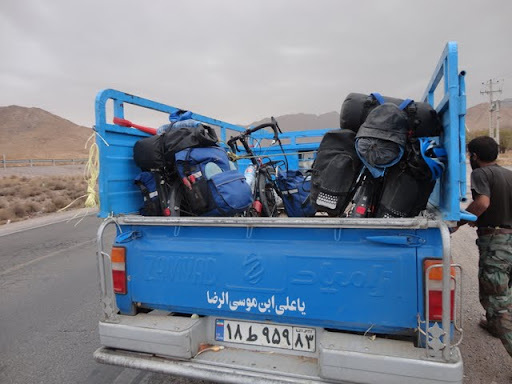
Yosof hauls onions from Shiraz to Yazd and he has just dropped off a load. There is plenty of space for our bikes. We shave off close to a hundred kilometres of dusty desert riding and best of all, we avoid the head wind. Yosof drops us off in Abarqu where the only interesting thing is the 4000-year-old cypress tree. Not sure how accurate that figure is.

The next day is much of the same thing: The rain has cleared but the headwind is even stronger and the traffic is crazy. With no shoulder on the road, it doesn't make for ideal cycling conditions. So, we try our hand at our newly found skill; hitch-hiking. In about five minutes we get picked up by a small truck with a sealed cab.

That ride shaved off about fifty kilometres and gave us bad motion sickness. We are glad to get to the turn that is supposed to have less traffic. Guess what? It's just as busy. After several kilometres, we pull off for the night at an orchard. This one does not look abandoned but it has a small cubby hole that gives us total protection from the wind. Question is: Where is the owner and would he mind if we stayed the night? Well, probably not. Besides, we don't have a choice.

Sure enough, at six AM the guy shows up on his motorbike. He looks a bit annoyed but ends up cracking a smile when we finally manage to explain the situation. It was a bit awkward but at least we get an early start.
Sometimes travelling on a bike gets boring. Sleep, eat, cycle. This can go on for days with not much else happening. At least we have our new activity to keep us entertained; hitch-hiking! Yet another Zamionette picks us up to let us off at the top of a pass at 2800-metre elevation. At the bottom of the hill, on the other side, we set up camp again at an orchard this one at 2300 metres altitude. That night, we push the limit of our equipment by camping in subzero temperatures. Not sure how cold it got but the water in our water bottles was frozen the next morning. Luckily for us the rising sun is on our tent: Made out of non-breathable material, it warms up immediately.
After breakfast it's straight back onto another Zamionette for 30ish kilometres. The guy drops us off on the outskirts of a village where the road splits. Most of the traffic seems to be going one way. The other road looks relatively quiet. Finally, some ideal cycling conditions. The road leads us to the bottom of a steep hill where we decide to stop for lunch; eggplant and tuna: It wasn't very good. By the time we finish eating it's getting late. So we catch another Zamionette ride over the mountain pass. The driver stops at the next town where we hope to find a hotel. We don't want to camp in the cold again. Unfortunately we are shit out of luck on the hotel. So, the guy offers us to stay the night at his place. With no other choice we accept. As we roll into town, everyone stops their current activities to stare at the honkies piled in the back of the blue pickup. At the guy's place, the first thing I see is a guy huddled up to a heater, sleeping. Our driver wakes him up in order to give us the heater. It is the poorest family we've stayed with. Everyone there looked very tired as if a long day at work just ended. No-one expressed interest in us. Maybe even a bit annoyed that we are there. They didn't even ask where we were from: A question we usually get 20 times a day. We all sit around for what seems to be hours without trying to communicate anything. The only thing that seems to make them happy is a small child that was getting all the attention. In the kitchen, a woman is preparing dinner. Plucking a freshly killed chicken. In the meantime, our driver is watching a religious show on TV. Mildly motivated he occasionally mumbles a few prayers along with the sermon. The meal was delicious but a bit disturbing. Most of the food was given to us. Everybody else ate very little. Making us feel uneasy. After dinner they offer us their room for the night. We get into bed and close our eyes to open them back up the next morning where we quickly get back on our bikes and ride towards the sunrise. Shining like royalty in the crisp morning. Leaving the less fortunate behind. How lucky we are to be vagamonde.
For the morning at least, the travel gods grant us a bit more traffic free cycling.

The quiet road ends several kilometres from Persepolis: An ancient city of yesteryears turned tourist trap. From far away, the tall columns make it look like a factory. We get to the site with only an hour left before it closes so we decide to stay the night nearby. All the hotels are way too expensive. At one hotel, we ask if we can camp. The guy at reception is a snivelling little prick and I tell myself that, other than motorists, we have found our first asshole in Iran. He tells me that its $10 to camp and that there is no hot water for showers. When I ask him if we can borrow a blanket for the night he says no. He does all this in a very dismissive manner. If you happen to go by the Persepolis Tourist Complex, please give the finger to the guy at reception for us.
About a kilometre down the road, we find an army base that looks perfect for camping. Feeling desperate, I ask the guard if we can camp inside the compound. He says no but offers a spot just outside in front of the guard post. Not ideal but it will do for one night. Beats giving 10 bucks to an asshole. With the tent set up underneath barbed wire and next to a busy road, we try to get some rest. But the fatigue goes deeper then just being physically exhausted from the cycling. We need a real rest. A place where we can be isolated from the culture shock and be master of our domain. In other words a comfortable hotel room. In the meantime it's party time outside our tent. It's Thursday night and everyone's buddy is coming by to drink tea and smoke hookah. The traffic eventually dies off and the drinking buddies finally leave. We finally get a few hours of sleep to be woken up at six by the exhaust of a parked truck: The muffler directly aligned with our tent. I jump out of the tent to yell at the guy and motion for him to move his truck. Luckily he does. Rudely awakened, we pack up, say our thanks to the military guys and head to Persepolis.
At the ancient city there is the usual tourist-wrangling refuse. Here, it's guys trying to get you to ride their sorry-looking animals. Access to the site is cheap and as we enter it's an instant disappointment. Most of the place is roped off so that you can't really get a feel for it. There is a path that takes you around like a boring museum. There are glass barriers and flood lights at every interesting spot. But the biggest eye sore is the huge football stadium size roof standing over a section containing a staircase in mint condition. Maybe it's just me but the whole point of going to an ancient site is to get a sense of time travel and to imagine what the place was like in its heyday. At Persepolis, I guess they used to play a lot of football.
 Michèle comments: From Persepolis, it was about 50 kilometres to Shiraz. I wasn't ready to cycle the whole way. A serious exhaustion was setting in. If we hadn't been so tired, maybe we could have seen past the tourist shuffling setup and enjoyed Persepolis. Our lucky streak with hitching rides in the Zamionettes ended that day. Half way to Shiraz, we waved one down; the driver stepped out and right away started to motion with his fingers "Money, money." Not quite sure what to offer, because all our other attempts to give money to the Zamyad drivers were adamantly refused, Benoit hesitantly took a 50,000 rial bill out of his moneybelt. Roughly $5 worth. The guy grabbed the bill and pointed to the moneybelt, clearly wanting more. How much more? Five fingers outstretched while waving the 50,000 rial bill and then at one of our bikes. Did he want 250,000 rials? Or 250,000 rials per bicycle? We weren't sure, but then I realized that I didn't trust this guy and decided right there that I didn't want a ride from him. With anyone else, I would have been happy to contribute to gas money for getting a lift. This guy, however, had a greedy gleam in his eyes that didn't fit with the Iranian generosity that we had come to know. So I flatly refused to go with him. And so we cycled all the way to Shiraz. The exhaustion I was feeling intensified. It wasn't so much a physical exhaustion, even though the two climbs on the busy highway next to the belching trucks were very tiring. The traffic in Iran forces me to concentrate so much that it leaves me mentally drained. What I normally love about cycling is that it calms my mind, allowing it the freedom to wander aimlessly as if my thoughts were lightly bouncing from cloud to cloud. With a few exceptions, this hasn't been possible in Iran. My fingers rest on the brake levers, just in case some driver cuts me off; my eyes constantly dart to my rearview mirror, in case I have to bail onto the shoulder to avoid a charging truck; and every fibre in my body feels tense tense tense.
Some people love attention. I do too, in small doses. Out here it's hard to get a moment to yourself. It's always the same question "Hello mister ... Where are you from?". I can't recall having said the word "Canada" so many times. As a cyclist, you are mere entertainment to motorists and we are starting to feel like zoo animals. One time, a couple stopped to film us and hand us candy. Some people will cut you off while on the shoulder of a busy highway in order to park in front of you so they can ask you questions.
- Hello mister! I will try to run you over and then come and talk to you!
We find this behaviour extremely dangerous and it has forced us to be rude to the people: Usually ignoring them or motioning them to move along. We feel bad about this because we know they mean well, but when it happens 20 times a day, it starts to drive you crazy. At the pinnacle of all this was a car packed with young women wearing chadors. Hysteric, they cut in front of us several times to finally drive away with one of them sitting on the edge of the window yelling "I love you". It could be worse I guess. She could have said "Go home you fucking assholes".
 Michèle comments: Some people cannot hide their astonishment at seeing us. They stare, mouths agape; if they're driving, they'll slow to keep pace with us. And stare. The windows rolled down. I call those people the monkey-watchers. They'll snap photos without asking us first. They'll laugh amongst themselves while staring some more. We're just monkeys on display at the zoo. Some monkey-watchers try to go the extra step to shake our hands or to give us candy, but it feels like a weird gesture and leaves us feeling uncomfortable. On the opposite end of the spectrum from the monkey-watchers are the people who make every effort to speak to us. If they speak English, we would hear them say that this is the greatest day for them. If we don't have a language in common, the look on their faces and how they would clasp our hands would express so clearly how happy they are to meet us. They'd also extend an invitation for a meal, or to stay with them, or to help us in any way.
While in Shiraz we take care of things that have been collecting dust on our list; Administrative bullshit; Internet; Shopping and of course much more. At some point during our stay, we meet a group of cyclists. Among them is Loïc, a French cyclist who started in northern France three months ago. With a great sense of humour, he tells us about his trip so far: A journey we would call nightmarish but the stories are hilarious. Loïc started his trip with Roger: The incarnation of the stereotypical competitive French male. Out to prove something in the hope that somebody cares, Roger has weighed every last piece of equipment; omitting fenders and sawing off his toothbrush handle to increase performance. He has a sophisticated cycle computer and keeps track of all the useless statistics it spits out. At the start of their trip, with the whole village on their bikes to do the first few kilometres with them, Roger takes off like a rocket just to wait 20 minutes at the first roundabout. In the morning, Roger packs his equipment in half an hour to wait with a pouting look on his face; helmet on and bike straddled. Loïc tells us about Istanbul. Instead of staying a few days to visit this unique city, Roger insists on leaving at 5 PM to do the 60 odd kilometres of nightmare cycling to get out of the city. It's only at 11 PM that they finally find a spot to camp; because getting a hotel room would discredit you as an adventure cyclist. The stories go on and on as we piss ourselves with laughter. For Loïc, the last straw comes a few hundred kilometres from Tehran. With Roger pushing like a mad man, Loic admits he can't go on like this. They split in five minutes without saying goodbye. Last we heard was that Roger was already in India, averaging 150 kilometres a day. Bonne chance Roger, la France a besoin de toi.
Michèle comments: Shiraz started to feel like Laâyoune Plage in Morocco last December: a limbo land between countries, playing the waiting game before leaving. In Laâyoune Plage, we were waiting for the ferry to the Canary Islands. In Shiraz, we waited for our flight to Oman. Our bicycles sat on the balcony of our hotel room. Without them with us, we blended into the mix of tourists, not attracting any more attention than the occasional "Hello Mistère" or, my favourite, "Hey Lady" while snapping fingers. No interesting encounters. More often than not, our bicycles had been the starting point of a conversation, and then an invitation. Like Mohammed in Esfahan. I wonder if he would have approached us if we didn't have our bikes with us, if we were just two tourists strolling through the square. An early stop at Shiraz was necessary to renew our Iran visas about to expire. Once in Shiraz though, and settled into a cozy hotel, it soon dawned on us that we were through cycling in Iran. Finished. Nothing left in us even to ditch the bikes somewhere and tour around without them. So it came as a delightful surprise when all of a sudden we meet a huge crowd of cyclists in Shiraz. Tommie and Marie were there, whom we hadn't seen since Tabriz, as well as Geoffroy & Elodie from Belgium on recumbent tandem, whom we met briefly in Van Turkey. Also, Loïc (France) and Laurent & Gaëlle(Switzerland/France). All heading to India via the United Arab Emirates. And thrown into the mix of cyclists, a runner: Stéphane (France) who is running his way across from Europe towards India and Nepal with only a 7 kilo pack! We hope to see them again, maybe in India.


 Michèle comments: I am happy to have visited Iran. We met so many wonderful Iranians and saw so many amazing things. I loved that we could camp pretty much anywhere. I always felt completely safe, except, I have to say it again, when cycling in the insane traffic. We had a difficult time finding quiet secondary roads. For this reason, I would not call Iran a great cycling destination. But at least we had four great rides while in Iran, and those are the memories I will keep.
Well, so long Iran. All this prohibition is setting my belt to the last notch from the lack of beer.
All of our photos from Iran are
here.


